Chasing the Aurora: How a Chance Conversation Turned Into an Obsession
If you had told me a decade ago that I would spend countless nights staring at solar wind forecasts, cloud maps, magnetic field data, and driving hours into the dark hoping for a few minutes of green light in the sky, I probably would have laughed.
Yet today, few things excite me more than seeing the first faint pillar of an aurora appear above the horizon.
Aurora chasing has become much more than photography for me. It’s science, patience, hope, disappointment, adrenaline, community, and occasionally… pure magic.
This is the story of how it all began.
“There are moments in photography when you don’t just take a picture—you become a witness to something that has traveled millions of kilometers to reach you.”
It Started With One Photograph
Like many people, I grew up believing the Northern Lights belonged to places like Iceland, Norway, Alaska, or the northern territories of Canada.
Vancouver?
Never.
To me, Vancouver was simply too far south.
That belief changed because of one photograph.
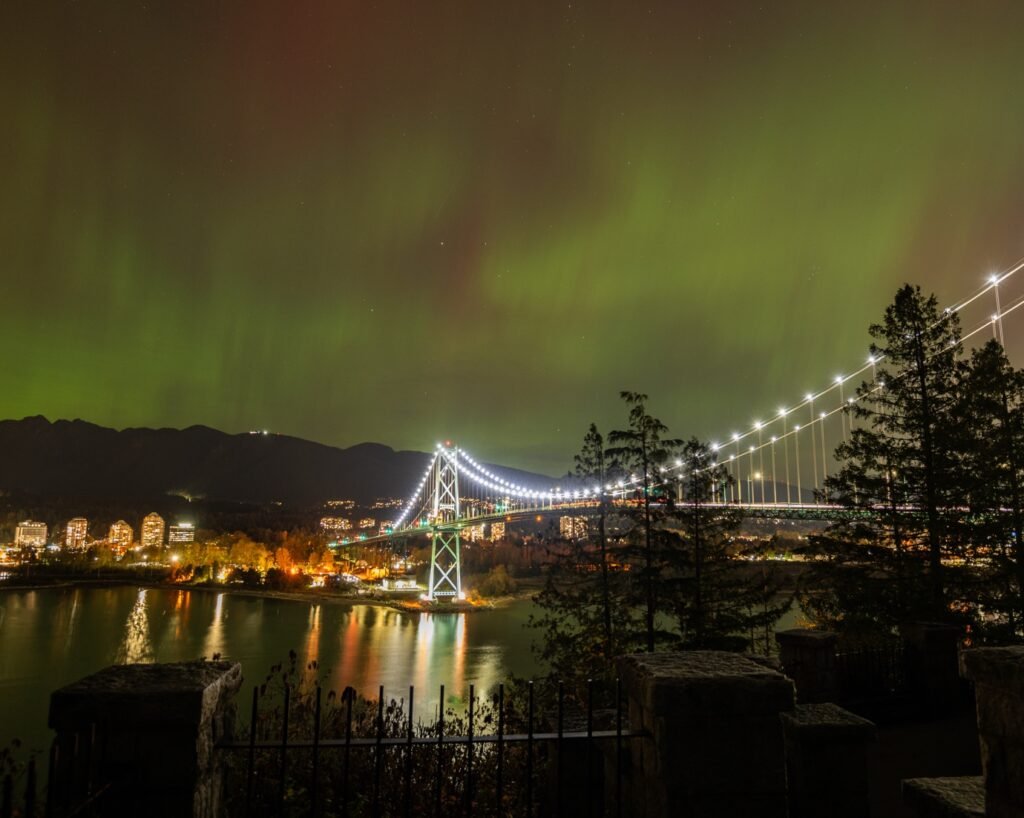
Several years ago, I met another photographer through local photography meetups. One day he shared an older image he’d taken from Vancouver showing green auroras glowing above the city lights.
I remember staring at the photo thinking…
“Wait… this was taken here?”
That single image completely changed my understanding.
It wasn’t that Vancouver regularly experienced auroras.
It was that during particularly strong solar storms, the auroral oval expands far enough south that even cities like Vancouver can witness them.
That realization sent me down what I can only describe as one of the deepest rabbit holes I’ve ever fallen into.
Falling Into the Science
The more I read, the more fascinating it became.
Auroras aren’t weather.
They aren’t atmospheric light pollution.
They’re actually the visible result of activity occurring 150 million kilometres away on the Sun.
The Sun constantly releases charged particles known as the solar wind. Most of the time Earth’s magnetic field shields us from these particles.
But occasionally, the Sun erupts.
Solar flares and Coronal Mass Ejections (CMEs) launch enormous clouds of charged particles toward Earth.
When these particles arrive—sometimes one to three days later—they interact with Earth’s magnetic field.
The magnetic field channels these particles toward the poles. As they collide with oxygen and nitrogen atoms high in our atmosphere, those atoms become energized before releasing light.
Different atoms produce different colours:
- Green (most common): Oxygen around 100–150 km altitude
- Red: Oxygen above 250 km
- Purple and Blue: Nitrogen
- Pink: Mixture of oxygen and nitrogen emissions
The stronger the geomagnetic storm, the farther south the auroras become visible.
That’s why Vancouver occasionally gets lucky. And when it does… Everything stops.
Discovering an Incredible Community
While researching, I stumbled upon a Facebook group called BC Aurora Enthusiasts.
At first I joined simply to know when auroras might happen.
Instead, I found an entire community.
Many members lived much farther north in British Columbia where auroras were more common.
Others were scientists.
Some were amateur astronomers.
Many were photographers.
People discussed:
- Solar wind speed
- Bz magnetic field orientation
- KP Index
- NOAA forecasts
- Cloud models
- Camera settings
- Space weather
Suddenly I wasn’t just learning photography.
I was learning space weather.
Night after night I began following forecasts, comparing predictions with real observations, and slowly understanding that aurora forecasting isn’t an exact science.
It’s probability.
Sometimes every indicator looks perfect…
…and nothing happens.
Other nights forecasts barely predict anything…
…and suddenly the sky explodes.
That unpredictability is part of what makes aurora chasing addictive.
The High That Keeps You Coming Back
Every aurora chaser knows this feeling.
You drive for hours.
It’s freezing.
Clouds roll in.
Nothing happens.
You wait.
You check your camera.
You refresh the forecast.
Still nothing.
Then…
A faint green arc appears.
Your camera sees it before your eyes do.
Minutes later the arc begins dancing.
Pillars shoot upward. Curtains ripple across the sky.
The entire landscape changes colour.
For a few moments, you’re no longer thinking about exposure settings or composition.
You’re simply watching.
No photograph has ever fully captured what that feels like.
That emotional rush is difficult to explain to someone who hasn’t experienced it.
Every successful aurora night creates a memory far stronger than the photograph itself.
And that’s what keeps me going back.
The Night Everything Changed
One particular night changed everything.
The geomagnetic storm was unusually strong.
Forecasts suggested Vancouver had a real opportunity.
I headed out with my Nikon Z6 and my trusted Nikon 16–35mm wide-angle lens on a weeknight. The city lights glowed beneath the green curtains.
It was one of those nights where you knew immediately that something special was happening.
I posted a few photographs on Instagram. Then something unexpected happened.
The post exploded.
People flooded my inbox asking:
“Is this real?”
“Where did you shoot this?”
“Was this actually Vancouver?”
“Can we still see it tonight?”
Many simply couldn’t believe auroras were visible from within city limits.
Then local news outlets picked up one of my photographs.
Seeing my image published by Vancouver news organizations was surreal.
It wasn’t about recognition. It was about sharing the excitement.
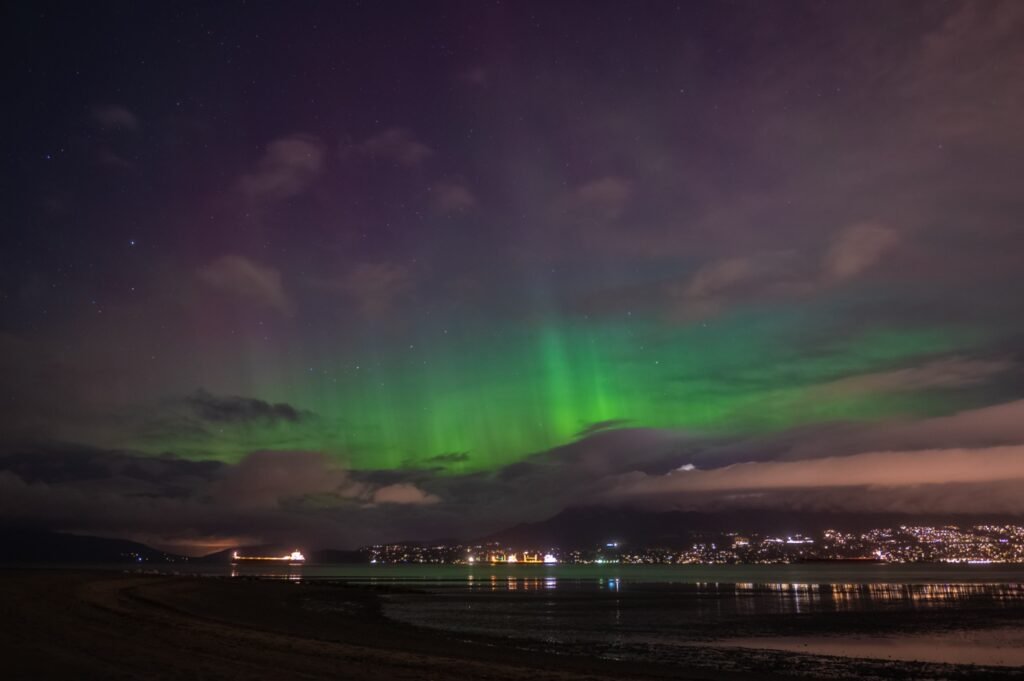
When Aurora Chasing Became a Vancouver Event
I certainly wouldn’t claim my photographs alone caused what happened next.
The real reason was simple:
The solar cycle reached one of its strongest periods in years.
People suddenly became aware that Vancouver could occasionally experience auroras.
My photographs happened to be part of that conversation.
The timing couldn’t have been better.
Soon social media filled with aurora images.
More people began following NOAA forecasts.
Local photography groups started discussing solar storms.
Popular viewing locations that had once been nearly empty became packed.
Places I’d previously visited with only a handful of photographers suddenly had dozens—or sometimes hundreds—of people.
Parking lots overflowed. Tripods lined the shore. Everyone looked north.
It felt like an entire city had collectively discovered a hidden phenomenon.
That was incredibly rewarding to witness.
Photographing the Aurora
People often ask me what gear I use.
Honestly, you don’t need the most expensive camera.
Good technique matters far more.
Most of my aurora photographs were captured using:
- Nikon Z6
- Nikon 16–35mm f/4 wide-angle lens
- Sturdy tripod
- Remote shutter or intervalometer
Recommended Camera Settings
Mode: Manual
File Format: RAW
White Balance: Auto or 3500–4000K
Focus: Manual (focus on a bright star)
Aperture: Widest available (f/2.8–f/4)
ISO: 1600–6400
Exposure:
- Fast-moving aurora: 2–5 seconds
- Moderate activity: 5–10 seconds
- Faint aurora: 10–20 seconds
Avoid exposures that are too long.
Auroras move surprisingly quickly.
Long exposures blur the beautiful curtains and structure.
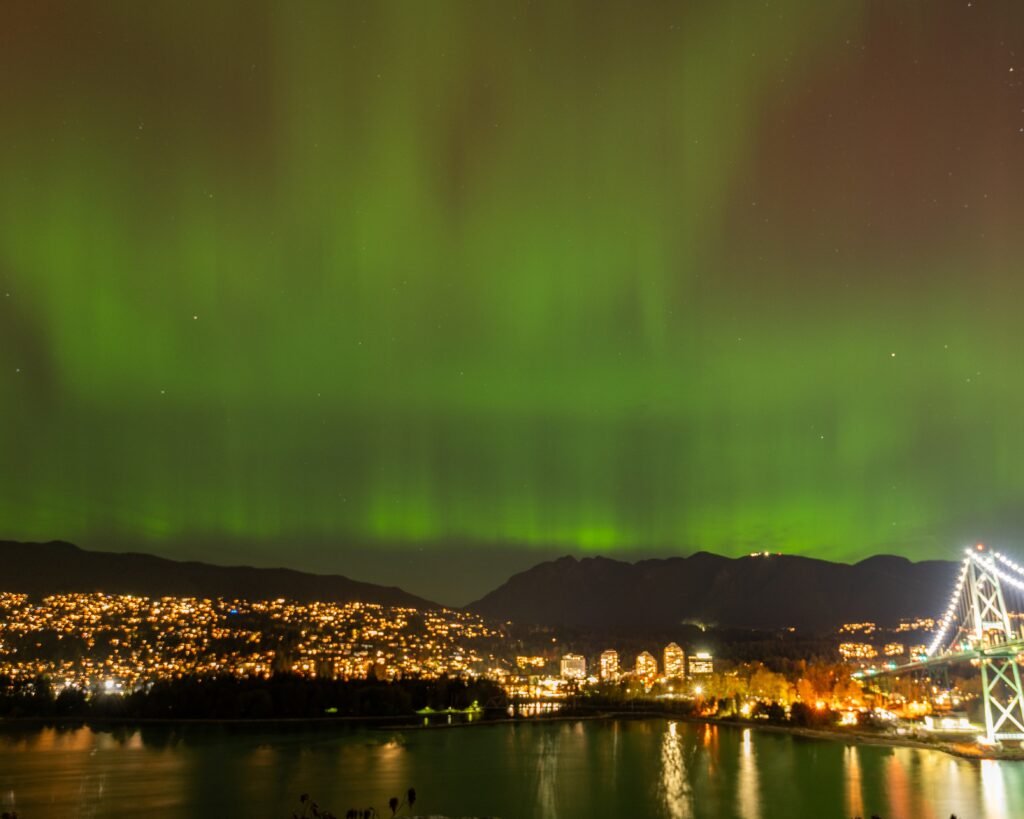
Choosing the Right Location
A few things dramatically improve your chances.
1. Find Dark Skies
Less city light means stronger contrast.
2. Look North
Especially in hilly areas at higher latitude regions.
3. Check Clouds
Clear skies matter more than forecast strength.
4. Watch Moon Phase
A bright moon can wash out faint auroras.
5. Monitor Space Weather
Useful resources include:
- NOAA Space Weather Prediction Center
- SpaceWeatherLive
- Aurora Forecast apps
- Local aurora communities like BC Aurora Enthusiasts
Going Beyond the Ordinary
After photographing dozens of aurora displays, I wanted something different.
Many aurora photographs look similar.
Beautiful…
…but similar.
So I started experimenting.
Instead of taking a single exposure…
I began combining auroras with star trails.
That introduced an entirely new challenge. The aurora moves rapidly.
Stars rotate around Earth’s axis.
Capturing both together requires planning and patience.
The results, however, create images that show both the motion of Earth and the energy arriving from the Sun.
Two completely different astronomical phenomena in a single frame. Those remain some of my favorite images I’ve ever created.
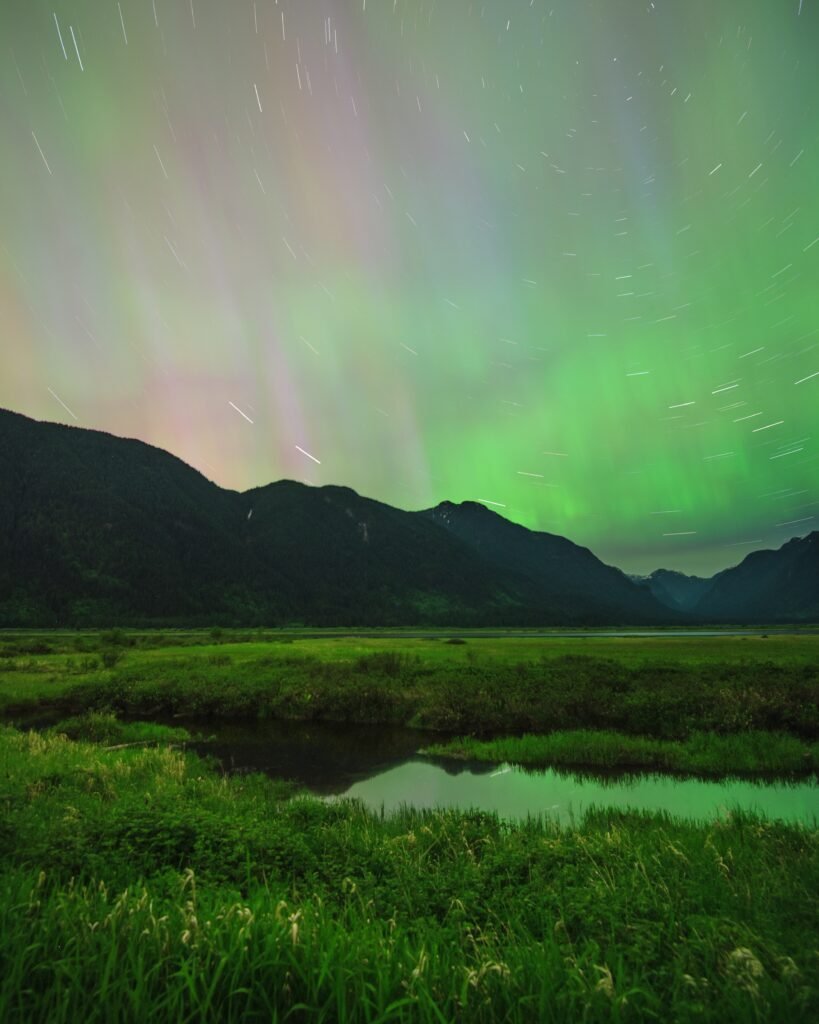
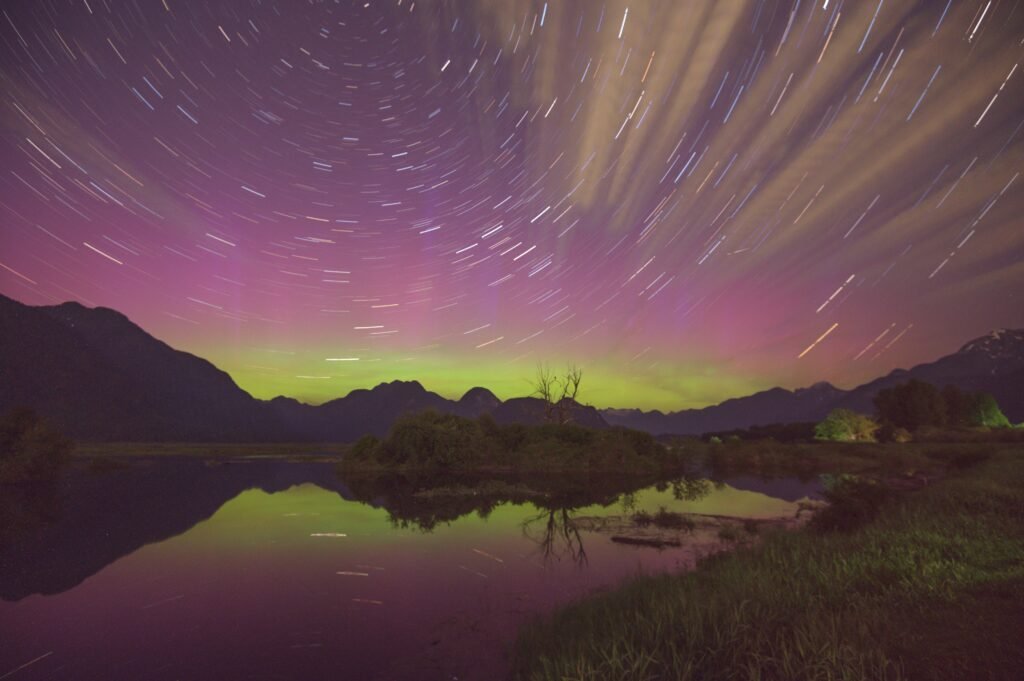
How to Shoot Aurora Star Trails
Method 1 – Using an Intervalometer
This gives the most flexibility.
Settings
- Manual exposure
- RAW
- Manual focus
- Aperture: Wide open
- ISO: 1600–3200
- Exposure: 8–15 seconds
- Interval: 1 second (or shortest possible)
Capture anywhere from:
- 200–600 images
Later, stack them using software such as:
- StarStaX
- Starry Landscape Stacker (Mac)
- Sequator (Windows)
- Photoshop
This creates smooth star trails while preserving the evolving aurora.
Method 2 – Using the Camera’s Built-in Interval Timer
Many modern Nikon cameras include an Interval Timer Shooting mode.
Steps:
- Switch to Manual mode.
- Set exposure (for example, 10 seconds).
- Open the Interval Timer menu.
- Set interval slightly longer than exposure (e.g., 11 seconds for a 10-second exposure).
- Choose the number of shots (300–500).
- Start shooting.
- Stack the resulting RAW images later.
This method eliminates the need for an external intervalometer and works beautifully with the Nikon Z6.
Lessons Aurora Chasing Has Taught Me
Aurora chasing has taught me far more than photography.
It has taught me patience. Forecasts fail. Clouds appear. Equipment freezes. Batteries die.
Hours of driving sometimes end with nothing.
And yet… You go again.
Because the next night might be the one. It has also taught me humility.
Nature doesn’t care about your schedule. The sky performs on its own terms.
You simply show up and hope you’re invited.
Why I Still Love to Chase Them When I get a chance
People often ask whether photographing dozens of auroras eventually becomes routine.
The answer is no.
Every display is different.
Every solar storm tells a different story.
Every location changes the experience.
Sometimes the aurora quietly glows above distant mountains. Sometimes it dances violently overhead.
Sometimes it reflects in calm lakes. Sometimes it appears above city skylines, reminding us that extraordinary things can happen in ordinary places.
No two nights have ever been the same.
Looking Back
When I think back to that first conversation with another photographer—the one simple photograph that showed auroras above Vancouver—I realize how much can change because of a single moment of curiosity.
One image led me into astronomy.
Astronomy led me into photography.
Photography led me into an incredible community.
That community eventually led to one of my own images being shared across local news and inspiring conversations with thousands of people who suddenly realized that the Northern Lights weren’t just something you had to travel to Iceland to see.
If my photographs encouraged even a handful of people to look up, drive out under the stars, or experience their very first aurora, then every late night, every failed forecast, and every freezing drive was worth it.
The Northern Lights remind us that we are connected to something unimaginably larger than ourselves. Every shimmering curtain in the night sky is the visible signature of events unfolding on the surface of a star 150 million kilometers away, interacting with an invisible magnetic shield that quietly protects our planet every day.
That’s what still amazes me.
Not just the photographs.
Not the news articles.
Not the viral social media post.
But the realization that every time I point my camera toward the northern horizon, I’m watching the Sun and Earth have a conversation.
And every once in a while, if the timing is right and the skies are clear, we’re lucky enough to witness it together.