
15 Photography Composition Rules Every Beginner Should Know
A Simple Guide to Taking Amazing Photos
Have you ever looked at a beautiful photo and wondered, “Why does this picture look so good?”
The answer is not always an expensive camera. Many great photos are created because the photographer understands composition.
Composition means how you arrange everything inside your photo. It helps the viewer know where to look first. A good composition can turn an ordinary picture into an unforgettable one.
The best part is that you don’t need a costly camera. You can learn these rules using your mobile phone too.
In this article, you will learn the most important photography composition rules in very simple language. Each rule also includes practical tips that you can try immediately.
Let’s begin!
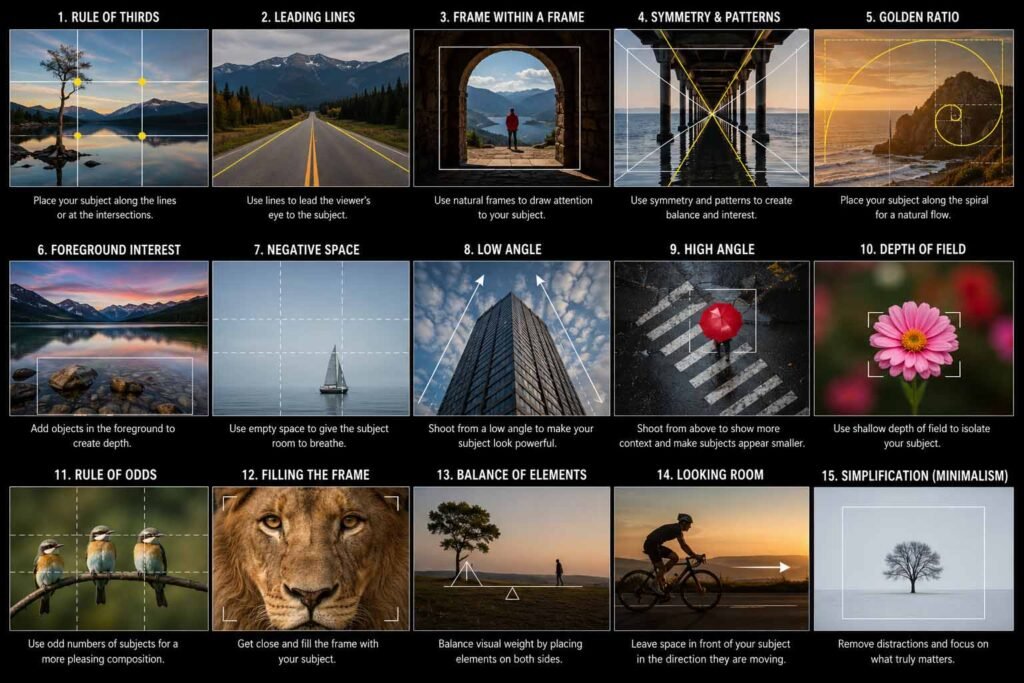
Rule of Thirds
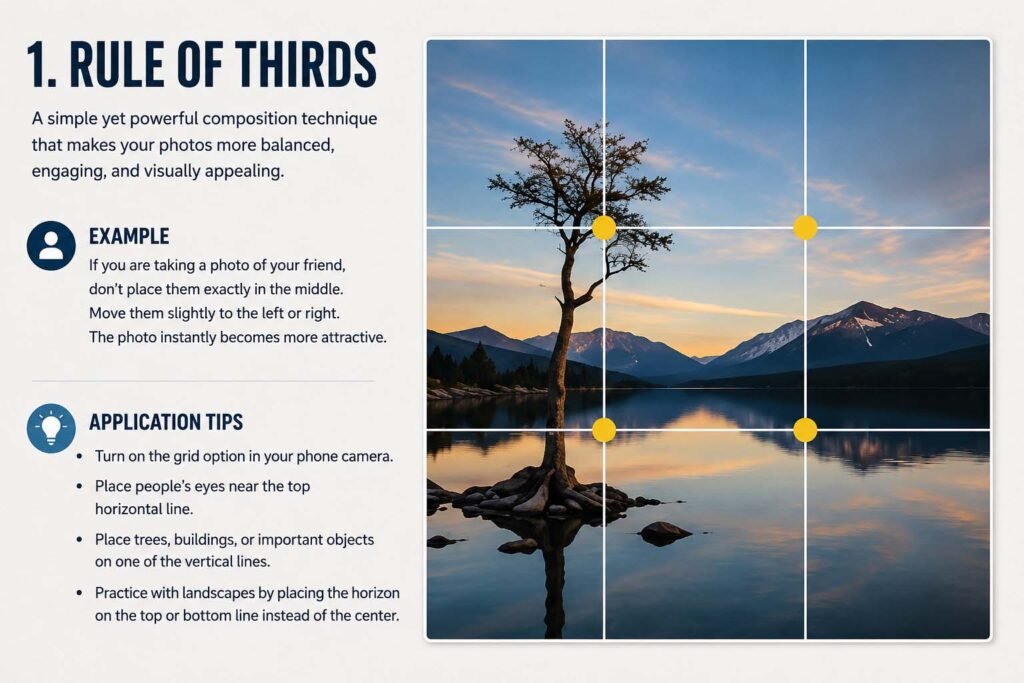
The Rule of Thirds is one of the first things every photographer should learn.
Imagine your photo is divided into 9 equal boxes by 2 horizontal lines and 2 vertical lines.
Instead of placing your subject exactly in the center, place it along these lines or where the lines meet.
This makes the picture look more interesting and natural.
2. Leading Lines
Leading lines are lines that guide the viewer’s eyes toward your subject.
These lines can be natural or man-made.
Examples include:
- Roads
- Railway tracks
- Bridges
- Rivers
- Footpaths
- Fences
- Staircases
- Shadows
These lines help tell the viewer where to look.

3. Frame Within a Frame
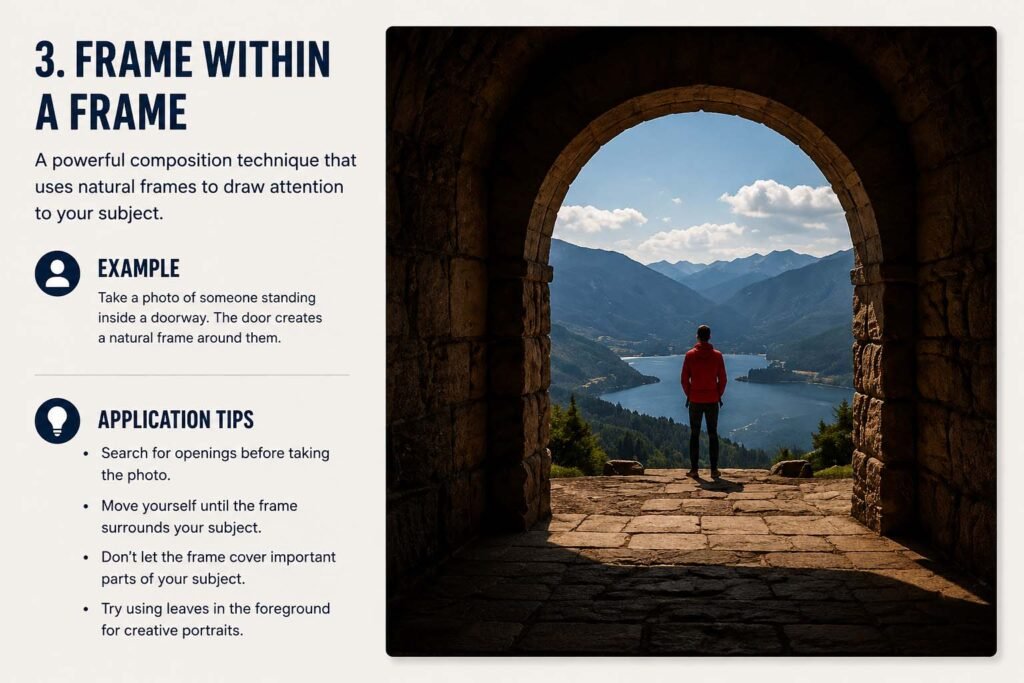
Sometimes you can use objects around your subject to create another frame.
This helps the viewer focus only on the main subject.
Natural frames include:
- Windows
- Doors
- Tree branches
- Flowers
- Arches
- Gates
4. Symmetry and Patterns
Our eyes love balance and repeating shapes.
Patterns make photos look neat and satisfying.
Examples include:
- Building windows
- Floor tiles
- Stairs
- Chairs
- Rows of trees
- Reflections in water
Sometimes breaking the pattern makes the subject stand out even more.

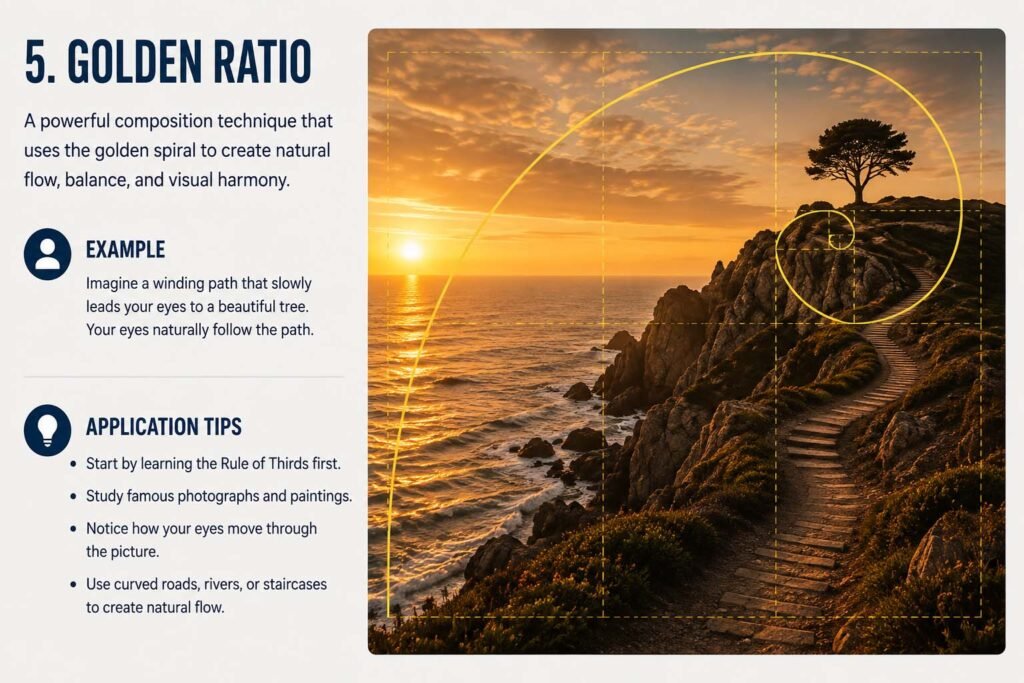
5. Golden Ratio
The Golden Ratio is a more advanced version of the Rule of Thirds.
Instead of straight lines, it follows a spiral shape.
The viewer’s eyes naturally move through the image until they reach the main subject.
Don’t worry if this sounds difficult.
Many famous photographers use it without even thinking about it.
6. Foreground Interest
A flat photo often looks boring.
Adding something in the foreground creates depth.
It makes the viewer feel like they are inside the scene.
Foreground objects can be:
- Flowers
- Rocks
- Grass
- Leaves
- Water
- Fences

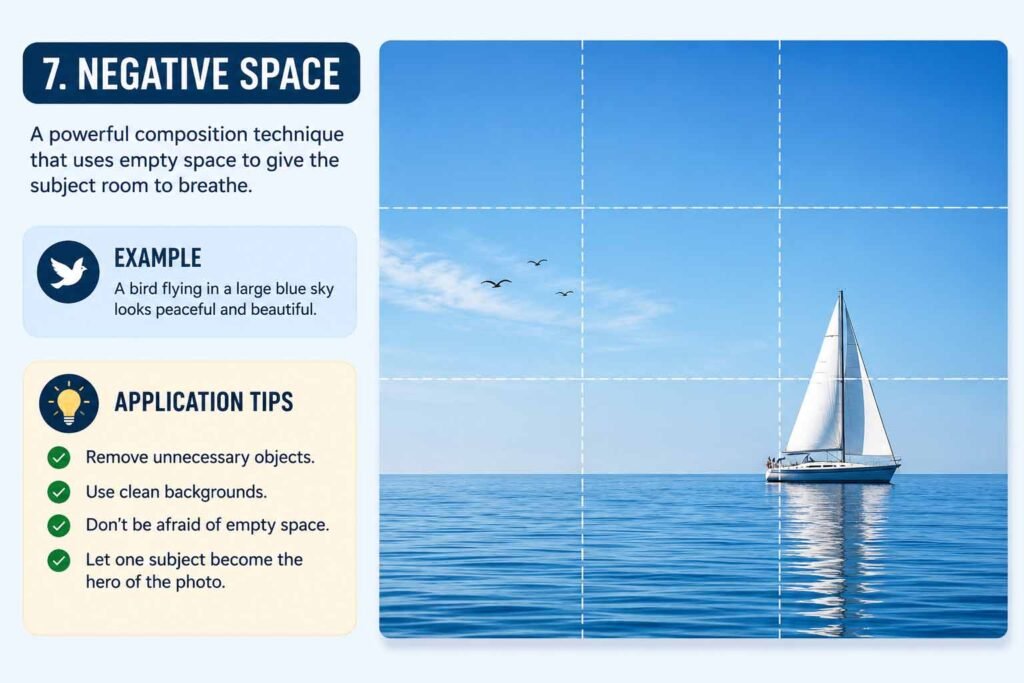
7. Negative Space
Many beginners try to fill every part of the picture.
But empty space can actually make your subject stronger.
Negative space is the empty area around your subject.
It could be:
- Blue sky
- Empty wall
- Calm water
- Plain background
This gives your subject room to “breathe.”
8. Low Angle (Worm’s Eye View)
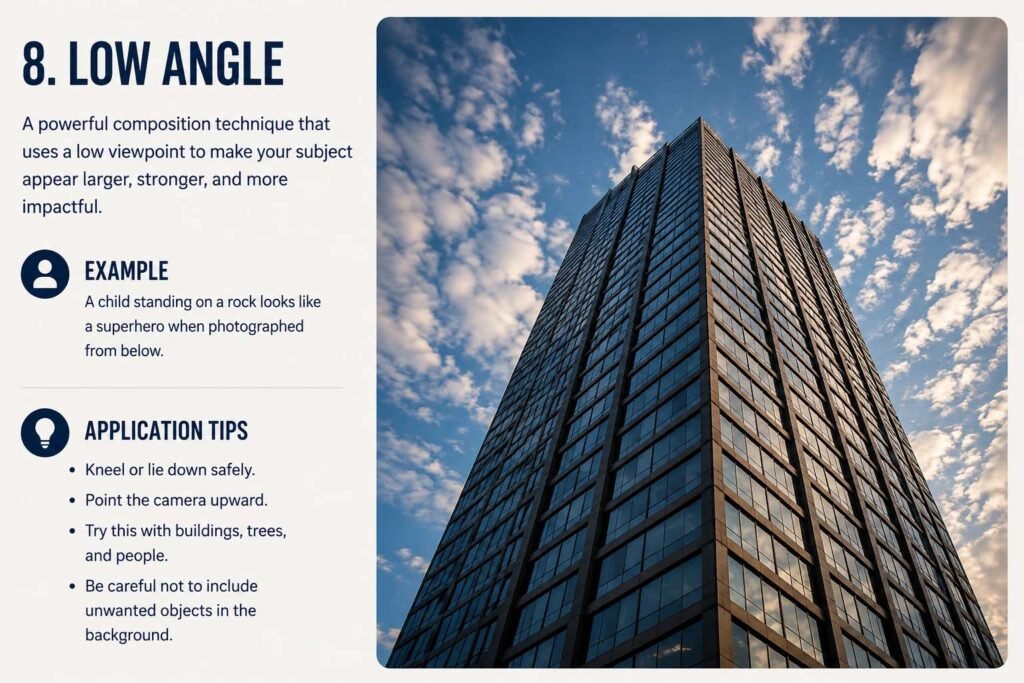
Take photos from near the ground.
Looking upward makes your subject appear taller and stronger.
9. High Angle (Bird’s Eye View)
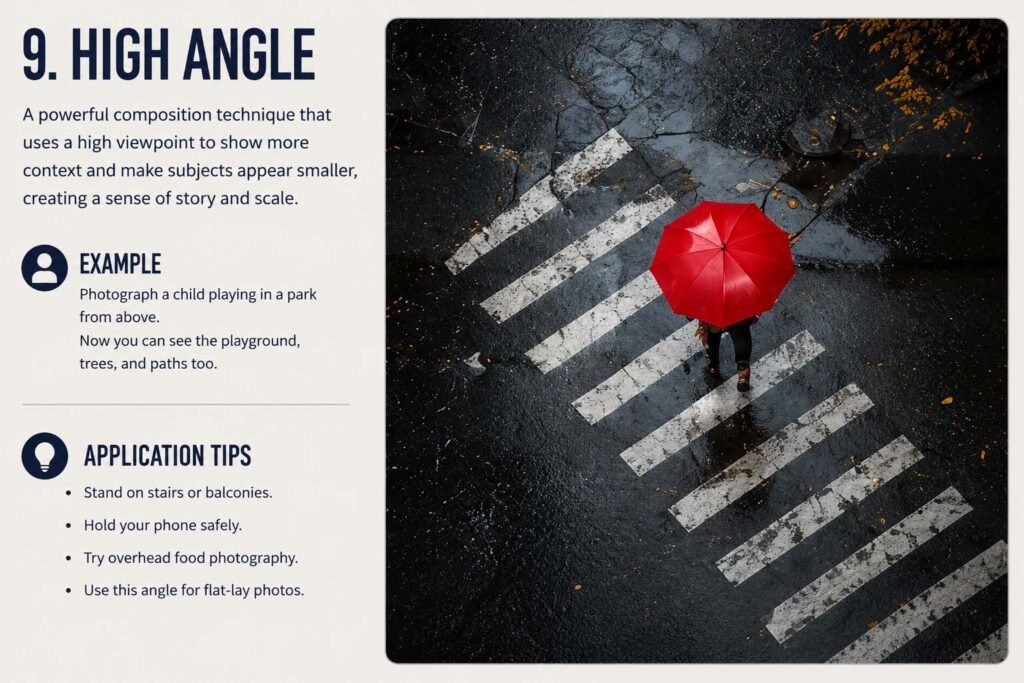
Taking photos from above gives a completely different feeling.
The subject appears smaller.
You can also show more of the surroundings.
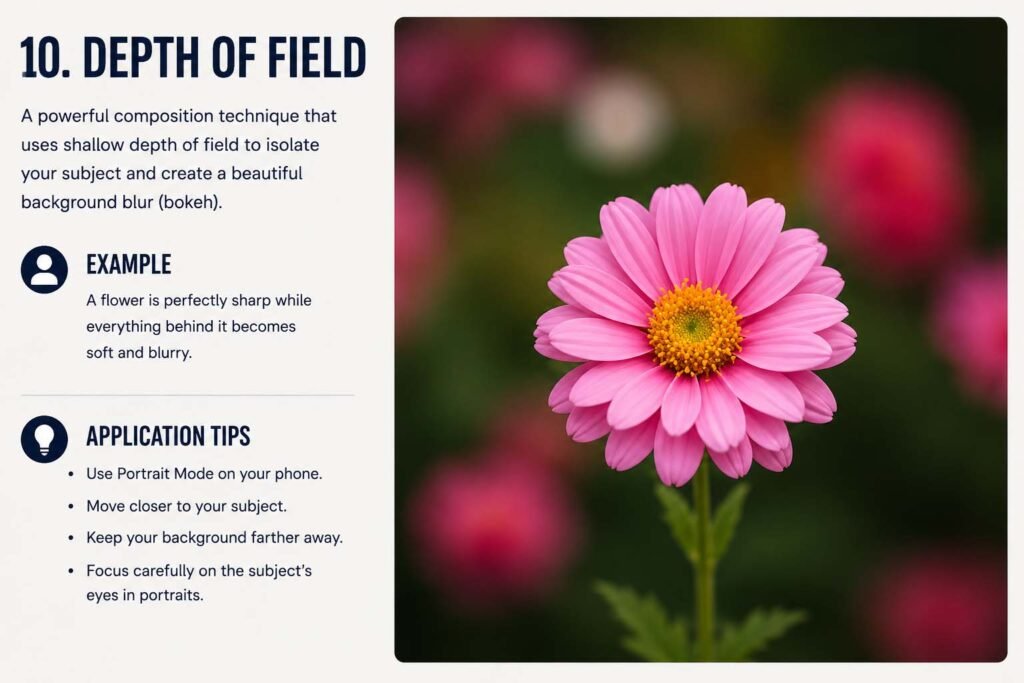
10. Depth of Field (Selective Focus)
Sometimes you want only your subject to be sharp while the background becomes blurry.
This is called shallow depth of field.
It removes distractions and keeps attention on the subject.
11. Rule of Odds
Odd numbers look more natural than even numbers.
Three objects often look better than two.
Five objects often look better than four.

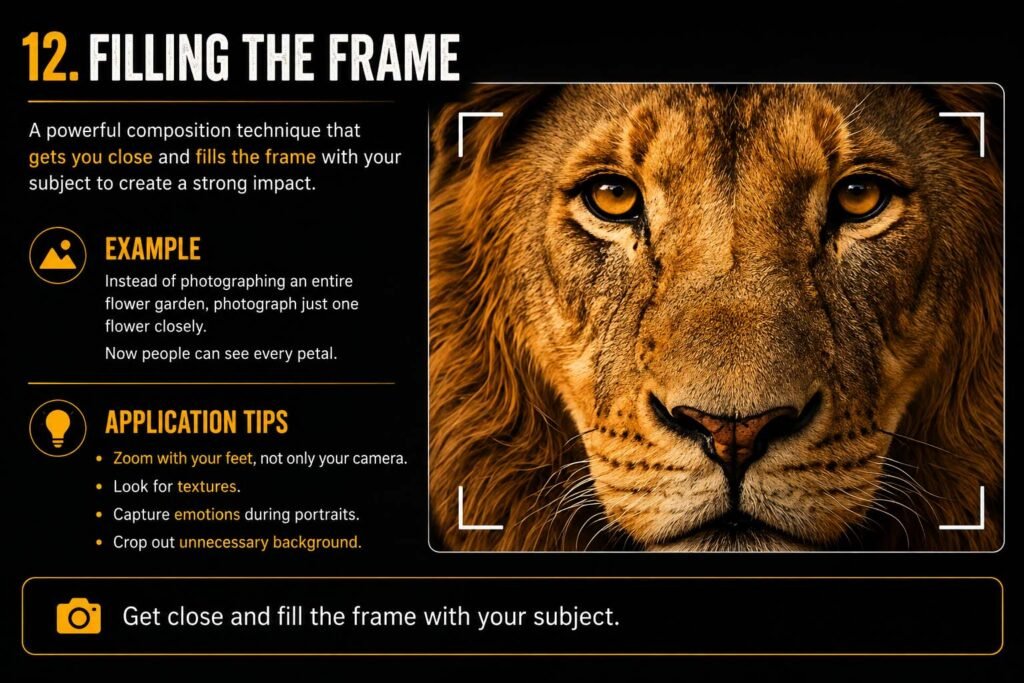
12. Filling the Frame
Sometimes the best photo is the closest one.
Move closer.
Fill most of the picture with your subject.
This removes distractions and shows details.
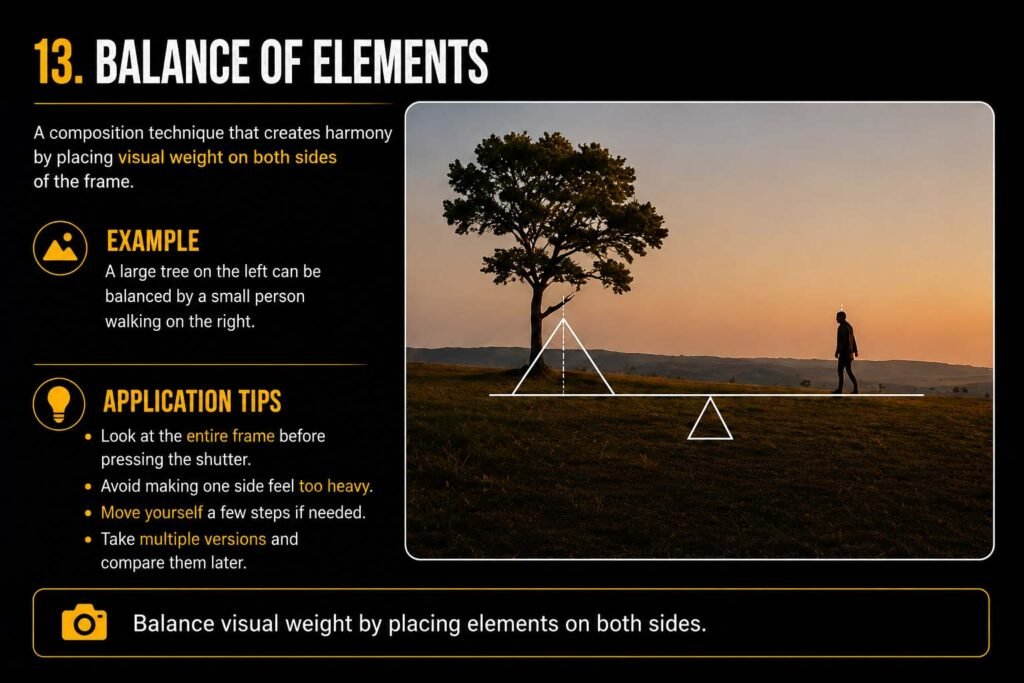
13. Balance of Elements
A photo feels comfortable when both sides look balanced.
If one side has a large subject, the other side can have a smaller object.
This creates harmony.
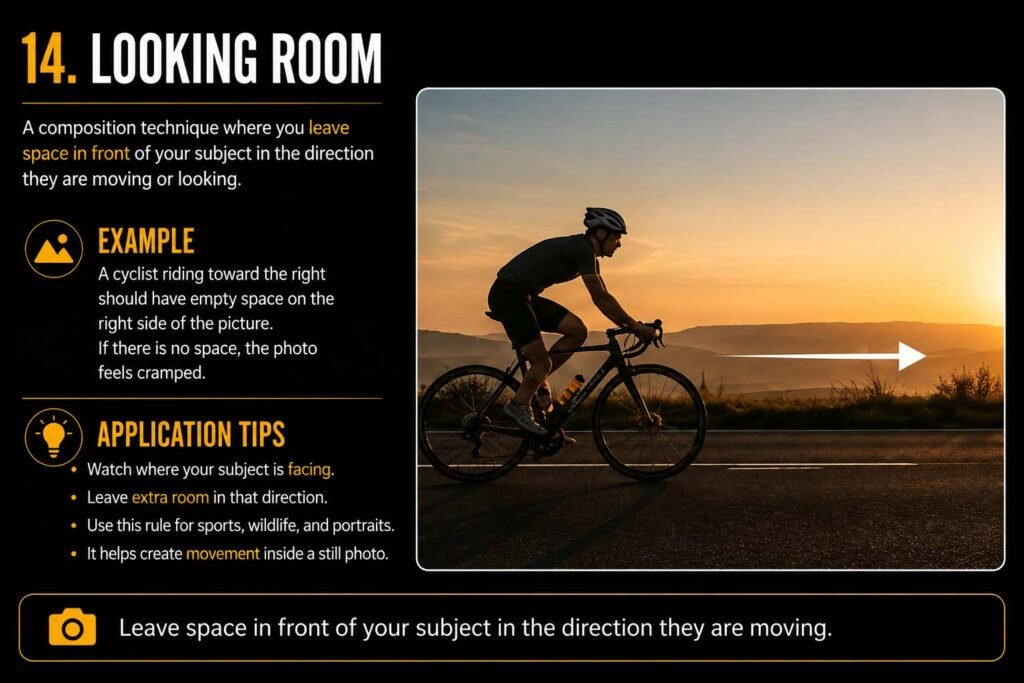
14. Looking Room (Movement Room)
If someone is looking or walking in one direction, leave empty space in front of them.
This gives the feeling that they have somewhere to go.
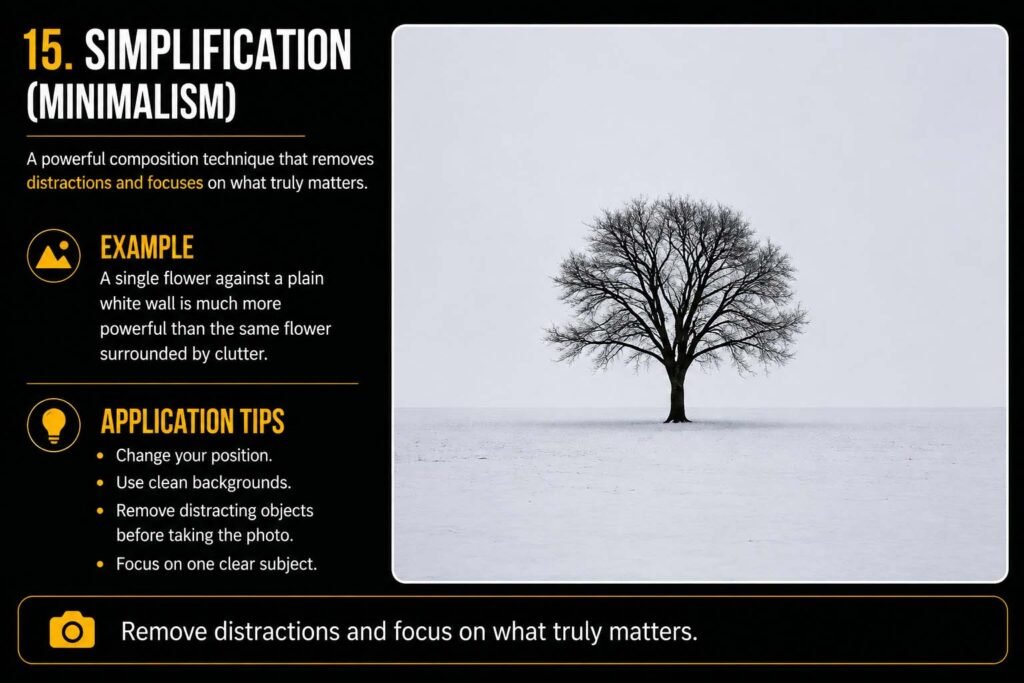
15. Simplification (Minimalism)
One of the biggest mistakes beginners make is including too many things.
Ask yourself one simple question:
“Does this object help tell my story?”
If the answer is no, remove it.
Simple photos are often the strongest.
Practice Is More Important Than Equipment
Many beginners believe they need an expensive camera.
That is not true.
A photographer with good composition can create amazing images using a smartphone.
The secret is to practice regularly.
Here are a few fun challenges:
- Take one Rule of Thirds photo every day.
- Find five examples of leading lines near your home.
- Capture reflections after rain.
- Photograph one object using negative space.
- Shoot the same subject from high and low angles.
- Create a minimalist photo with only one subject.
The more you practice, the faster your eyes will notice beautiful compositions.
Final Thoughts
Photography is more than pressing a button. It is the art of telling stories with light, shapes, and emotions.
These composition rules are not strict laws. They are simple guidelines that help you create stronger, more beautiful photographs. As you gain experience, you can even break these rules creatively to develop your own style.
Remember these simple ideas:
- Think before you click.
- Keep your background clean.
- Use light wisely.
- Practice every day.
- Experiment with different angles.
- Learn from every photo you take.
Every great photographer started as a beginner. The camera does not make the photographer—your creativity, observation, and practice do.
So pick up your camera or smartphone, step outside, and start creating amazing photographs. Every click is a chance to learn, improve, and tell a beautiful story.
If you liked this post, share your comments below..


Thank you for sharing such valuable information on creating images using composition rules. The guidance was insightful, helpful, and greatly appreciated
Thank you for the fantastic breakdown on composition rules. This was exceptionally helpful.
Thank you for sharing this informative and thought-provoking blog post. I found the ideas you presented to be eye-opening, and they challenged my preconceptions on the topic. To explore more, click here.